Hybrid Training for Longevity: Build Strength, Engine, and Resilience
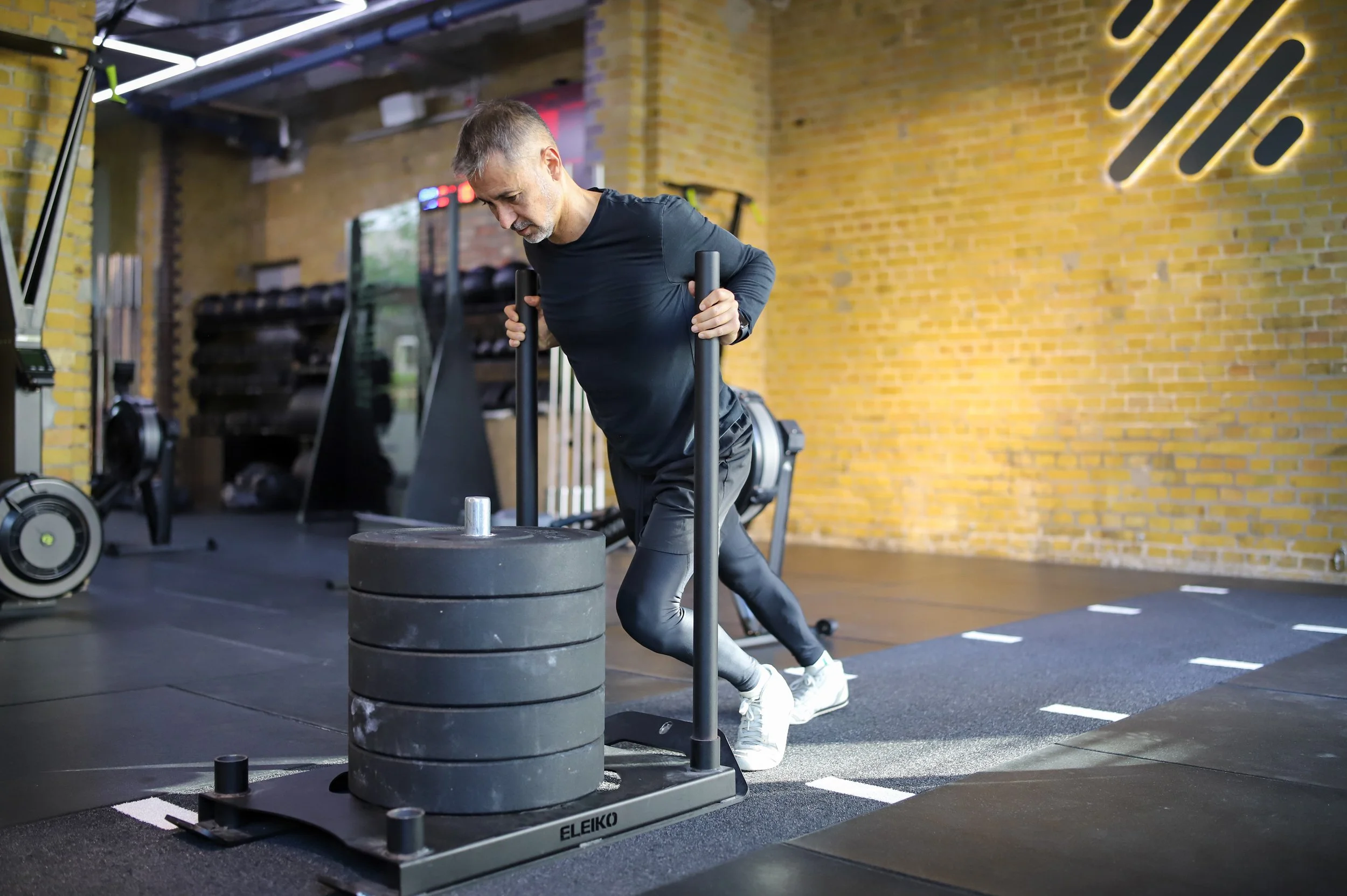
If you train for hybrid races long enough, you learn a blunt truth: getting fit is easy to build, staying fit is the hard part.
In my 50s, longevity stopped meaning “train less” and started meaning “train with better judgment.” Not softer, clearer, or more repeatable. More intentional about the usual stress points, Achilles, knees, spine, and shoulders, because those are what typically end training blocks, not motivation.
Most athletes I meet don’t lack grit. They lack structure. Their week becomes a stack of sessions that are all “pretty hard,” and over time that turns into fatigue, tightness, and inconsistent output.
Here’s the framework I use to stay competitive and keep training months stacking.
The 3-rule framework
Rule 1: Two strength exposures per week, non-negotiable for durability
I’ve made this mistake more than once. I lean into conditioning, strength becomes optional, and for a few weeks, I feel great, lighter, faster, fit. Then things start to add up.
I can usually trace it back to the same gaps: not enough isometric and plyometric tendon work, not enough rotational strength and trunk control, and not enough recovery between high-output days. That’s when Achilles gets sensitive, knees get noisy, my back starts to feel compressed, and shoulders get tight under the volume I actually enjoy.
Strength is structural reserve. It’s the buffer that lets you keep training consistently across months.
For hybrid athletes, strength is not a vanity metric, it’s tendon capacity, bone density, joint resilience, and force production, the base that makes running, carries, lunges, pulls, and pushes more sustainable.
Rule 2: Polarize your conditioning, keep each session’s intent clear
The biggest shift that kept me progressing wasn’t more intensity, it was clearer intent.
Most hybrid athletes don’t go wrong by training hard. They go wrong by training too hard, too often. They stack multiple sessions in the same middle zone, hard enough to drain recovery, not focused enough to drive a clean adaptation. That gray zone pattern is a common reason for performance stalls.
Polarizing your conditioning means separating the week into distinct jobs.
One hard day, speed or intervals, short, focused, high-quality output.
One easy day, Zone 2, truly conversational, low stress.
One longer, easier, steadier day, durability, and pacing.
Polarized doesn’t mean extreme; it means purposeful. Hard sessions are controlled; easy sessions still require discipline. The difference is that each session has a purpose, and you don’t accidentally turn everything into a test.
What I mean by intent
Intent is the answer to one question: What am I trying to improve today?
Speed day intent, higher peak output, and better repeatability, fast reps that stay clean.
Zone 2 intent, aerobic base, and recovery capacity.
Long run intent, durability, fuel efficiency, and pacing under time.
When intent is clear, you don’t chase a feeling; you chase adaptation.
Zone 2, a simple way to know you’re doing it right
Talk test: You can speak in full sentences without pausing every few words.
Breathing, mostly nasal breathing, is possible, not mandatory, but a good check.
Feel, I could do this for a while, not this is a workout.
Consistent low to moderate intensity work supports mitochondrial and capillary adaptations in skeletal muscle, more engine room and better oxygen delivery, especially when done consistently over time.
How recovery capacity relates to lactate threshold, brief and useful
Lactate isn’t the enemy; it’s fuel your body can reuse. As your aerobic base improves, you get better at producing energy with less stress and better at clearing and reusing lactate during steady work. The practical result is simple: the pace or power you can hold before effort turns into that acidic spiral shifts upward, which many people experience as an improved lactate or ventilatory threshold.
Rule 3: Use a limiter system, adjust volume before intensity
Good training plans assume imperfect weeks. Work stress, sleep, and life happen.
Instead of guessing, I use a simple decision rule:
If you feel run down, reduce volume first, fewer sets, fewer reps, shorter session.
Keep intensity clean, quality reps, controlled intervals.
Avoid trying to make up missed intensity later in the week.
That’s what keeps training consistent over months, and it becomes more valuable with age.

Why I keep emphasizing tendons and joints
In hybrid training, your limiter is often tissue tolerance, not your drive.
Achilles matters because it stores and releases elastic energy on every stride, and it adapts slowly. Knees take load from squats, lunges, deceleration, and volume. Your spine, back, and trunk control are the transfer station for carries, hinging, rotation, and posture under fatigue. Shoulders and neck alignment affect how well you can pull, press, breathe, and stay tall when it gets heavy.
That’s why I program strength and tissue capacity on purpose, it’s performance insurance.
Recovery tools, heat vs cold, practical judgment
I like sauna and cold, I just don’t treat them like religion.
Cold after strength: why timing matters
If strength and muscle are a priority, I don’t default to cold immediately after lifting every time. Regular cold exposure right after resistance training can blunt parts of the adaptation signal you actually want from lifting, so I use it selectively, for example, during high-fatigue weeks when soreness is limiting training quality.
Heat is useful, not magic
Heat, sauna, or warm showers can support relaxation and recovery routines, but it doesn’t replace the foundations.
Foundations first, sleep, nutrition, and a smart weekly structure. Tools come after.
In my 50s, the goal isn’t to prove I can suffer. It’s to build weeks I can repeat, progress, and show up again next week with the same quality. When your week stays simple, and your intent stays clear, your body stops feeling like a problem to manage and starts feeling like a tool you can trust. That’s what real strength looks like over time, not the hardest single day, but the ability to return, ready, not fragile.
Recent studies/meta-studies (links)
1) Cold water immersion + hypertrophy (systematic review/meta), https://pmc.ncbi.nlm.nih.gov/articles/PMC11235606/. 2) Cold water immersion after resistance exercise + strength (meta-analysis), https://pubmed.ncbi.nlm.nih.gov/35068365/. 3) Mechanisms: CWI attenuates anabolic signaling / satellite cells (paper, mechanistic), https://pmc.ncbi.nlm.nih.gov/articles/PMC4594298/.
4) Cooling reduces myofibrillar protein synthesis post resistance exercise (study), https://physoc.onlinelibrary.wiley.com/doi/full/10.1113/JP278996. 5) Polarized training vs other intensity distributions (systematic review/meta), https://pubmed.ncbi.nlm.nih.gov/38717713/. 6) Concurrent strength + endurance training: sex/training status, interference context (systematic review/meta),
https://link.springer.com/article/10.1007/s40279-023-01943-9. 7) Exercise training effects on mitochondrial content + capillarization (systematic review/meta-regression), https://pmc.ncbi.nlm.nih.gov/articles/PMC11787188/. 8) Capillarization adaptations with aerobic exercise (review), https://www.frontiersin.org/journals/physiology/articles/10.3389/fphys.2025.1681184/full. 9) Post-exercise heat exposure: recovery/adaptation evidence (systematic review), https://pmc.ncbi.nlm.nih.gov/articles/PMC12488549/n ready, not fragile.
